
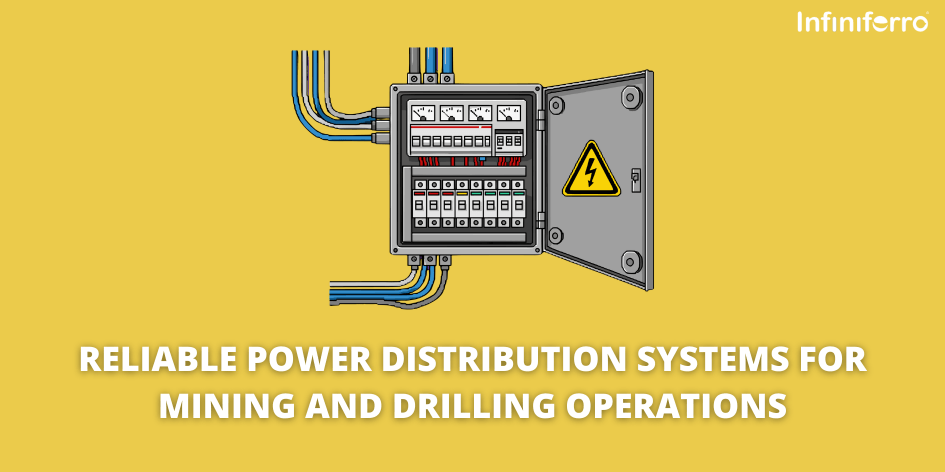
“When power weakness begins affecting drilling, pumping, and daily output, the real cost shows up fast. This guide explains how better power distribution design strengthens reliability, protects critical water systems, supports safer operations, and helps mining sites avoid expensive interruptions.”
Reliable power distribution in mining and drilling is not just a utility function. It is the electrical foundation for production continuity, safe access, effective drainage, stable drilling performance, and protection of both people and equipment in some of the harshest operating environments in industry. Mines and drill sites place unusual demands on electrical systems: layouts change, loads move, cable runs lengthen, water conditions shift, and large motors often share the same broader network as control systems, instrumentation, and communications.
For that reason, reliability in this sector cannot be measured simply by whether equipment is energized. A distribution system is truly reliable only when it can maintain voltage at the point of use, correctly clear faults, preserve grounding integrity, support critical water-handling loads, and keep essential functions operating even as the site expands or changes configuration.
In practice, reliable mining power is an engineering result. It depends on topology, segmentation, cable strategy, protection coordination, load prioritization, disciplined change control, and dependable access to replacement relays, control hardware, and monitoring devices through a trusted electronic components shop when field conditions demand fast recovery.
Why Reliability Is Different in Mining and Drilling
Mining and drilling operations challenge electrical systems in ways that fixed industrial plants often do not. Loads are scattered, mobile, mechanically exposed, and subjected to dust, vibration, moisture, shock, and heat. Distribution equipment may have to serve pumps, drills, loading machines, compressors, drives, PLC-based controls, monitoring devices, and communications systems across long distances and changing work areas. As cable runs increase and connected loads evolve, voltage drop, reduced fault current, overheating risk, nuisance tripping, and weak motor performance all become more difficult to manage.
That is why reliable distribution in mining and drilling requires more than spare capacity. It requires an architecture that recognizes different load types, isolates failure points, and allows the operation to keep functioning when one branch is maintained, relocated, or taken out of service. A mine power system should therefore be designed around the consequences of failure rather than around the convenience of installation. The more severe the operational impact of losing a feeder, the stronger the case for segmentation, alternate supply capability, or closer-to-load distribution.
Building the Right Distribution Architecture
The best-performing systems begin with a clear electrical hierarchy. Power should enter at a voltage suitable for efficient transmission, then step down near the point of use through substations, e-houses, or field distribution boxes located close enough to major loads that final cable runs remain short, controllable, and easier to protect. This is especially important in mining and drilling because the farther power is extended through trailing or feed-through cables, the harder it becomes to manage voltage, starting performance, fault response, and future expansion.
A well-structured architecture should divide the system into manageable zones. Major pump stations, drill bays, mobile equipment areas, control-power branches, and non-critical auxiliaries should not all depend on the same weak downstream segment. Branch-level segmentation improves reliability because faults, overloads, or maintenance work in one area do not need to disable unrelated equipment. It also improves expansion flexibility, since modular field substations and sectionalized distribution can be moved or extended without forcing the entire network to rely on one increasingly long feeder.
In practical terms, the architecture should be chosen according to risk. Radial distribution may be acceptable for temporary or lower-criticality areas where an outage affects only non-essential loads and can be restored quickly. Sectionalized distribution is usually preferable where there are multiple active production zones, advancing headings, distributed pump stations, or drilling areas that should be isolated independently. Redundant or alternate-fed arrangements become justified when losing one feeder would stop primary drainage, interrupt drill control systems, disable key monitoring, or halt a high-value production area.
Controlling Voltage Drop Across Long Cable Runs
Long cable runs are one of the most common causes of hidden unreliability in mines and drill sites. A feeder may appear acceptable at installation, yet gradually become weak as the heading advances, additional loads are added, or starting duty becomes more demanding. The consequences usually appear before total failure: motors struggle during starting, cable temperatures rise, control systems become unstable, trip events increase, and equipment performance deteriorates under load.
Reliable systems treat voltage drop as a design limit, not as a field complaint to be addressed later. High-demand loads should be grouped intelligently, major starts should not be stacked on the same weak branch, and distribution points should be moved closer to advancing work areas before low voltage becomes routine. As a working design discipline, the goal should be to keep steady-state voltage drop within a conservative range for normal operation and to prevent starting conditions from dragging voltage low enough to stall motors, disturb drives, or reset controls. When remote loads begin showing weak starts, low torque, dimming, nuisance trips, or recurring alarms during simultaneous duty, the system is already signaling that the feeder arrangement or cable strategy needs correction.
The best fixes are usually structural rather than cosmetic. They include shortening the electrical path, upsizing cable, relocating field distribution, dedicating supply to high-starting loads, staggering starts, or separating motor duty from sensitive control duty. In mining and drilling, a feeder that is merely “working” can still be the feeder that causes tomorrow’s stalled drill, overheated cable, or underperforming drainage pump.

Designing Protection That Still Works Under Fault Conditions
Protection is where reliability and safety become inseparable. A mine system is not truly reliable if it keeps running while allowing dangerous touch voltages, hidden ground faults, or poorly coordinated trips to develop. In this environment, protective devices must do more than interrupt obvious faults. They must remain technically correct at the end of long cable runs, under reduced fault-current conditions, and after the system has been changed, extended, or partially reconfigured.
Grounding continuity must be monitored on a failsafe basis, and protective functions must remain effective even if components fail. Breaker and relay settings should be calibrated, labeled, secured, and matched to the actual available fault current. Just as important, those settings cannot be treated as permanent. When cable lengths change, mobile boxes are relocated, pumps are added, or a new drill line is connected, the fault current seen at the end of the branch can change enough to affect protection performance. Short-circuit analysis and coordination review should therefore be updated whenever the system changes in ways that materially affect branch conditions.
This is also where many operations create avoidable reliability problems. A feeder may have enough capacity to run the load, yet still be poorly protected because the available fault current at the end of the circuit is lower than the original study assumed. The result can be delayed clearing, miscoordination, nuisance trips, or unsafe fault behavior. Reliable systems avoid that trap by treating protection review as an ongoing engineering responsibility rather than a commissioning task that is never revisited.
Stabilizing Power for Drill Rigs, Pumps, and Control Systems
Mining and drilling loads do not behave the same way electrically, so they should not all be treated the same in the distribution design. Drill rigs, large pumps, compressors, hydraulic power packs, and other heavy motor-driven loads create starting stress, transient disturbances, and high branch demand. PLC panels, instrumentation, communications systems, relays, and supervisory controls require cleaner and more stable supply conditions. When both groups are left riding on the same unstable branch, even minor disturbances can turn into repeated downtime.
A practical approach is to divide the system into three electrical classes. The first includes heavy motor loads such as dewatering pumps, drilling water pumps, compressors, and major rig auxiliaries. These loads require feeders sized for starting duty, acceptable remote voltage, and protection coordinated for reduced fault levels at the end of long runs. The second includes control and automation loads such as PLC panels, instrumentation, communication systems, monitoring devices, and relay power. These should be supplied from electrically cleaner branches or protected control-power arrangements rather than being exposed to every large motor start on the network. The third includes non-critical auxiliary loads that can tolerate interruption without immediate production or safety consequences.
This classification makes it easier to decide what must be segregated and where stronger reliability measures are justified. Sensitive controls should always be separated from heavy fluctuating motor duty. Primary dewatering pumps, drilling water systems, central communications, and control systems whose failure would stop production or create recovery risk should be treated as higher-priority electrical loads. By contrast, service loads with limited operational consequence can usually remain on simpler single-fed branches.
Dual supply is not necessary for every load, but it is justified where the loss of a feeder would immediately threaten water control, safe access, production continuity, or system visibility. Typical candidates include main dewatering stations, pump control panels in flood-prone zones, central monitoring and communications systems, and drill control systems where power loss creates disproportionate downtime or restart risk. The design goal is not universal redundancy. It is selective resilience based on the actual cost of failure.
Treating Drainage and Drilling Water as Critical Loads
Drainage and drilling water systems are often treated as support services, but in mining and drilling, they are uptime-critical infrastructure because their loss can quickly disrupt access, drilling performance, safety conditions, and production continuity. Dewatering pumps, sump circuits, drilling water pumps, flushing systems, and transfer pumps directly influence whether headings remain usable, access roads stay open, boreholes perform correctly, and production delays are avoided. When water movement fails, the effects quickly spread to safety, access, equipment health, and production uptime.
That reality should be reflected in the distribution scheme. Water-handling loads should be clearly identified as critical or high-priority during design, rather than treated the same as non-essential auxiliaries. Their feeders should have adequate starting support, strong protection discipline, clear alarm logic, and priority in both maintenance planning and power-system review. In higher-risk areas, alternate supply paths or standby arrangements may be justified, particularly where pump interruption could cause flooding, loss of access, or rapid operational degradation.
From a decision-making standpoint, drainage and drilling water systems are often among the first loads that deserve electrical hardening. If an operation is choosing where to invest first in reliability, stronger support for primary water-handling circuits usually produces more practical value than broad upgrades to lower-consequence services. In mines and drill sites, water control is often one of the clearest dividing lines between a resilient operation and one that becomes unstable under stress.
Managing Mobile Cables and Distribution Equipment in Active Workings
Even a well-designed power system can be undermined by poor physical deployment. In mining, electrical reliability depends not only on diagrams and settings but also on how cables, boxes, and field equipment are handled in active workings. Trailing cables live where vehicles move, where rock shifts, where splices are stressed, and where temporary arrangements can quietly become long-term liabilities. Many recurring “electrical” failures are actually cable-management failures that later show up as voltage loss, phase imbalance, trip events, overheating, or shock hazards.
That is why cable routing, support, storage, mechanical protection, splice quality, and shift-level inspection should be treated as reliability controls rather than housekeeping tasks. Damaged cables should be removed from service immediately, roadway crossings should be properly protected, and excess cable should not be left stored in a way that encourages overheating or physical damage. Around mobile drills and portable equipment, distribution boxes should be positioned so that relocation does not constantly create weak cable geometry, unprotected crossings, or makeshift branch extensions.
Reliable systems assume that mechanical handling is part of electrical performance. A feeder can be perfectly sized and correctly protected on paper, yet still become unreliable in practice because the cable is repeatedly abused, poorly routed, or inadequately supported. In mining and drilling environments, physical discipline is part of electrical engineering.
Using Monitoring and Change Control to Prevent Hidden Failures
A mine or drill site rarely remains electrically static. Headings advance, pumps are added, cable lengths increase, mobile boxes are relocated, new drill rigs arrive, and seasonal water conditions change the duty cycle of critical equipment. Because of that, reliability depends on active change control rather than on a good initial installation alone. Hidden failures usually begin when the system evolves, but the engineering assumptions behind it do not.
Operators should therefore manage the electrical system with the same discipline used for production and maintenance planning. Up-to-date one-line diagrams, verified relay and breaker settings, feeder loading records, ground-monitor test routines, and change approval procedures should be standard operating tools rather than occasional documentation exercises. When new loads are added or distribution is extended, the review should include actual cable lengths, loading implications, remote voltage conditions, and whether existing fault studies and protective settings still reflect the system as built.
Routine monitoring should focus on the conditions most likely to reveal deterioration early. Weekly review is often appropriate for cable condition, abnormal trip events, repeated operator complaints, and unusual behavior from pumps, drills, or controls in active areas. A monthly or change-triggered review is more appropriate for one-lines, loading trends, protection settings, ground-monitor verification, and short-circuit implications following system changes. The purpose of this discipline is simple: to catch gradual instability before it becomes an outage, a flood event, or a production interruption.
Design Checklist for Reliable Mining and Drilling Power Distribution
Before finalizing, expanding, or reviewing a mining or drilling distribution system, decision-makers should be able to answer the following questions clearly:
✓ Have drainage, drilling water, drill control, and monitoring systems been identified as critical loads?
✓ Is the distribution topology appropriate for the consequence of losing a feeder: radial, sectionalized, or redundant?
✓ Are heavy motor loads separated from sensitive controls and instrumentation?
✓ Are remote voltage conditions acceptable during worst-case starting and full-load operation?
✓ Are protection settings based on current cable lengths, fault levels, and actual connected equipment?
✓ Are grounding continuity and ground-monitor functions routinely verified?
✓ Are mobile cables routed, supported, stored, and repaired in ways that preserve both safety and reliability?
✓ Are one-line diagrams, settings, and fault-current assumptions updated whenever the system changes?
✓ Are there defined review triggers for added rigs, added pumps, seasonal water changes, repeated unexplained trips, or expanding headings?
A reliable system is usually the result of consistently getting these fundamentals right, rather than relying on a single oversized feeder or a one-time installation effort.
The Real Standard of Reliability
The most reliable power distribution systems for mining and drilling operations are not defined by installed capacity alone. They are defined by structure, selectivity, grounding integrity, physical protection, and the ability to keep critical loads stable as the operation changes. They account for long cable runs from the beginning, treat reduced fault current as a design reality, separate sensitive controls from harsh motor duty, and give drainage and drilling water systems the electrical priority they deserve.
Certain features should be treated as non-negotiable in serious operations: coordinated protection based on actual system conditions, dependable grounding continuity, disciplined cable management, effective branch segmentation, and active review whenever the network changes. Just as important, operators should know when the system needs correction. Repeated trips, growing voltage complaints, unstable control power, expanding cable lengths, increased pump duty, or undocumented changes are all signs that the distribution design may no longer match operational reality.
The real standard of reliability is therefore simple but demanding. The system must keep the loads that decide uptime and safety electrically stable, selectively protected, and operationally manageable under actual mine conditions. When power distribution is designed and maintained to that standard, the operation not only recovers from failures more effectively, but also prevents many of them from developing in the first place.
ALSO READ:






Leave a Reply