
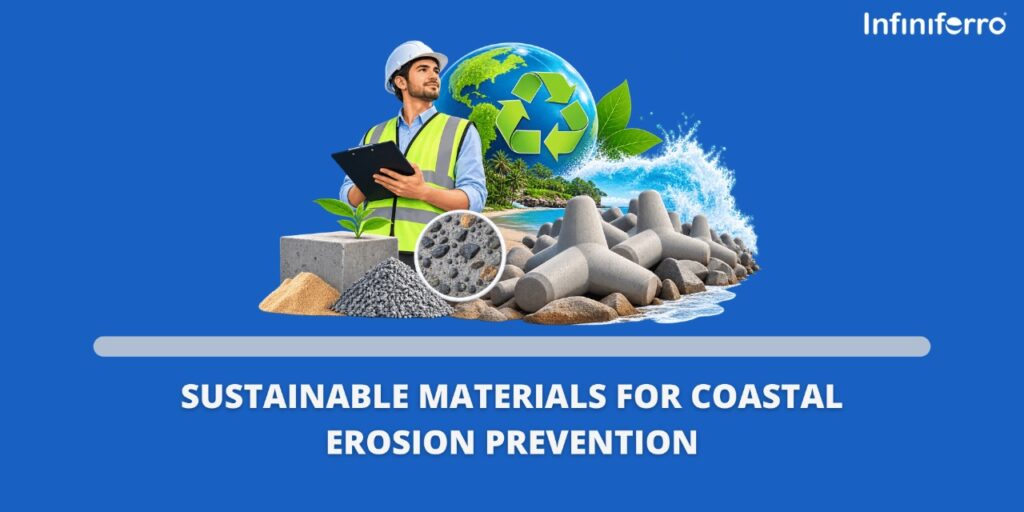
Coastal erosion is a major environmental challenge affecting coastal communities worldwide. One important solution to this issue is exploring sustainable materials for coastal construction. It occurs when waves, tides, currents, storms, and rising sea levels gradually remove sand, soil, and rock from shorelines. Although erosion is natural, its intensity has increased in many areas because of climate change, coastal development, vegetation loss, and human activities. The consequences include damage to buildings, roads, beaches, and natural habitats, along with increased risks to coastal infrastructure.
Traditional erosion-control methods, such as concrete seawalls, rock barriers, and timber structures, have been widely used to protect vulnerable shorelines. However, some conventional materials have environmental disadvantages, including high carbon emissions, corrosion, and limited recyclability. These concerns have encouraged engineers and construction professionals to explore sustainable alternatives. Recycled composites, bio-based materials, geotextiles, and low-carbon concrete are among the options being considered for environmentally responsible coastal protection.
Composite cladding is another important material in sustainable coastal construction. Although it cannot directly prevent shoreline erosion, it can protect buildings from harsh coastal conditions and improve infrastructure durability. When paired with effective erosion-control measures, sustainable construction materials can help build stronger, more environmentally responsible coastal communities.
Understanding Coastal Erosion
Coastal erosion occurs when waves, currents, and other natural forces remove sediment from a shoreline faster than it can be replaced. Continuous wave action gradually wears away beaches and cliffs, while strong storms can remove large amounts of sand quickly. Rising sea levels can also allow waves to reach farther inland, increasing the risk of flooding and shoreline retreat.
Human activities contribute to erosion in several ways. Construction near beaches, removing coastal vegetation, dredging, and port development can alter natural sediment movement. In some locations, hard coastal structures may protect one area while increasing erosion in neighboring areas by altering wave energy or sediment transport.
Coastal erosion threatens homes, tourism facilities, roads, industrial installations, and public infrastructure. It can also destroy important ecosystems, including dunes, wetlands, and mangrove forests. Effective prevention therefore requires suitable materials, responsible construction, environmental restoration, and careful coastal planning.
Importance of Sustainable Materials
Sustainable materials are products selected or developed to minimize environmental impacts throughout their life cycles. Their advantages may include reduced greenhouse gas emissions, lower consumption of virgin resources, improved durability, and better opportunities for reuse or recycling.
Coastal environments require careful material selection because structures face saltwater, humidity, ultraviolet radiation, strong winds, and changing temperatures. Materials that perform well inland may deteriorate more quickly near the sea. Sustainable materials should therefore resist weathering while minimizing pollution and maintenance needs.
Key characteristics include durability, low embodied carbon, responsible sourcing, corrosion resistance, and safe end-of-life management. However, a material is not automatically sustainable simply because it contains recycled content. You must also consider its manufacturing process, transportation, expected service life, and disposal options.
What Is Composite Cladding?
Composite cladding is an exterior covering manufactured by combining two or more materials to achieve useful properties such as strength, durability, moisture resistance, and reduced maintenance. Common examples include wood-plastic composite boards, fiber-reinforced polymer panels, and products manufactured from recycled plastics and wood fibers.
In coastal construction, composite cladding can protect building exteriors from salt spray, rain, humidity, and UV exposure. It is suitable for residential buildings, hotels, commercial facilities, waterfront developments, and selected marine infrastructure, provided the product meets relevant performance requirements.
A composite cladding system generally consists of panels or boards, a supporting framework, appropriate fasteners, and a drainage or ventilation arrangement. Select each component carefully to ensure the complete system performs reliably in coastal conditions. Corrosion-resistant fixings, secure attachments, and proper moisture management are particularly important.
Composite cladding is primarily designed to protect building surfaces. It does not replace seawalls, revetments, breakwaters, or other structures specifically engineered to resist coastal forces. Its contribution to coastal resilience comes from improving building durability and supporting sustainable development.
Types of Sustainable Composite Materials for Coastal Construction
1. Recycled Plastic-Wood Composites
Recycled plastic-wood composites combine wood fibers or wood flour with thermoplastic polymers. Some products use recycled polyethylene or polypropylene, reducing demand for virgin plastic and providing a potential use for selected waste materials. These composites are commonly used in exterior boards, decking, decorative facades, and screening systems.
Their moisture resistance can make them useful in coastal environments where untreated timber may deteriorate. Depending on their composition and installation, they may also require less frequent painting or protective treatment.
However, recycled plastic-wood composites can fade on the surface, expand thermally, and wear mechanically. Some are difficult to recycle because their constituent materials are combined. Therefore, choosing durable products with documented weathering performance and clear end-of-life instructions is important.
2. Fiber-Reinforced Polymer Composites
Fiber-reinforced polymer composites consist of reinforcing fibers embedded in a polymer matrix. Glass fibers are commonly used, while carbon fibers and natural fibers are selected for particular applications. These materials offer a high strength-to-weight ratio and good corrosion resistance.
In coastal construction, fiber-reinforced composites may be used for facade panels, protective covers, handrails, walkways, and selected marine components. Their resistance to saltwater-related corrosion can offer advantages over some conventional metal components.
Despite these benefits, certain fiber-reinforced composites are difficult to recycle, and their resins may have significant environmental impacts. Assess their suitability by considering manufacturing emissions, fire performance, ultraviolet resistance, maintenance needs, and end-of-life options.
3. Bio-Based Composite Materials
Bio-based composites use renewable materials such as hemp, flax, jute, bamboo, or agricultural residues as reinforcement or filler. When combined with suitable binders, they can be manufactured into panels, boards, and other construction products.
These materials may reduce dependence on fossil-based resources and provide useful applications for agricultural by-products. Their relatively low weight can also make them attractive for selected construction applications.
However, natural fibers can absorb moisture and become vulnerable to biological degradation. Protective treatments and suitable resin systems may improve performance, but their environmental effects must also be evaluated. Use bio-based composites in exposed coastal environments only when durability has been demonstrated for the intended conditions.
4. Low-Carbon Concrete and Mineral Composites
Concrete remains an important material for coastal engineering because of its strength and versatility. Conventional concrete production can have a substantial carbon footprint, particularly because of cement manufacturing. Low-carbon alternatives may reduce emissions by incorporating suitable supplementary cementitious materials, recycled aggregates, and more efficient structural designs.
These materials can be considered for seawalls, retaining structures, walkways, and other engineered coastal infrastructure. Their suitability depends on structural requirements, chloride exposure, abrasion, foundation conditions, and the expected service life.
Design and test low-carbon concrete according to the relevant coastal exposure conditions. Select recycled ingredients for technical suitability rather than simply to increase recycled content.
5. Geotextiles and Natural-Fiber Materials
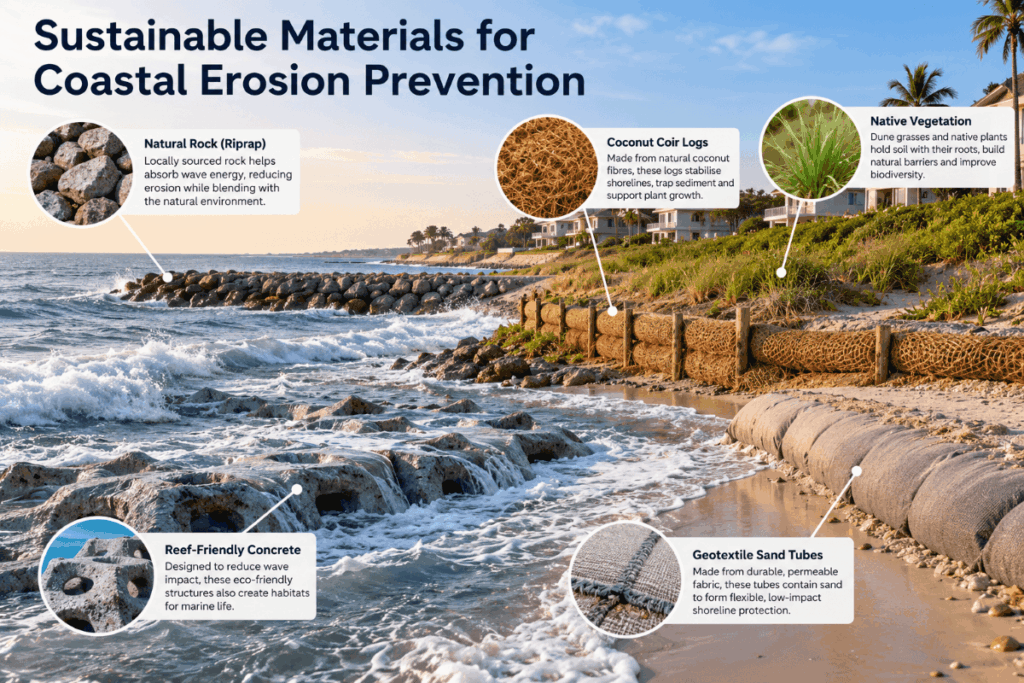
Geotextiles are permeable materials used in soil engineering to separate soil layers, filter water, reinforce ground, or help control erosion. Synthetic geotextiles can be used in appropriately designed shoreline stabilization systems, while natural-fiber products made from coir or jute may provide temporary protection.
Natural-fiber erosion-control mats can help retain surface soil while vegetation becomes established. They may be useful for stabilizing dunes, exposed slopes, and selected restoration sites where wave energy is relatively low.
However, these materials have different service lives and environmental implications. Natural fibers eventually degrade, while synthetic materials may persist in the environment if damaged or improperly managed. Their performance depends on wave conditions, currents, soil type, and installation quality.
How Sustainable Materials Help Prevent Coastal Erosion
Sustainable materials can help prevent coastal erosion through soil stabilization, infrastructure protection, and the restoration of natural coastal systems. Their effectiveness depends on their intended function and site conditions.
Geotextiles and erosion-control blankets can reduce loose soil movement and support vegetation establishment. Plant roots help bind soil, while stems and leaves can reduce wind and moving-water forces. In suitable locations, combining natural-fiber mats with native plants can provide a practical approach to erosion management.
Durable materials also help protect coastal infrastructure. Composite cladding can reduce exposure of exterior walls to salt spray, moisture, and weathering. This helps maintain the building envelope and may reduce the frequency of repairs. However, protecting a building facade does not prevent waves from removing beach sediment or causing cliff erosion.
Nature-based solutions are equally important. Mangrove restoration, dune rehabilitation, salt-marsh recovery, and other ecological approaches can help stabilize shorelines and reduce wave energy under suitable conditions. Sustainable materials can support these initiatives when they are selected to complement natural processes without creating unnecessary pollution.
Environmental Benefits of Composite Cladding
Composite cladding can offer several environmental benefits when its composition, manufacturing process, and expected service life are carefully considered. Products containing recycled plastics or reclaimed wood fibers may reduce demand for virgin resources and divert suitable waste materials from disposal.
Durability is another potential benefit. A cladding system that remains functional for many years may require fewer replacements, reducing the cumulative consumption of materials, transportation, and labor. Some composite products also require less frequent painting or protective treatment than traditional timber.
Certain composite panels are lightweight, which can reduce transportation demands and structural loads. Their design flexibility also lets manufacturers produce different shapes, textures, and finishes for coastal buildings.
Nevertheless, these benefits are not guaranteed. Plastic-based composites may release particles through abrasion or weathering, while some fiber-reinforced products are difficult to recycle. A complete life-cycle assessment should consider manufacturing, transportation, installation, maintenance, replacement, and final disposal.
Practical Strategies for Sustainable Coastal Construction
Successful coastal projects begin with an assessment of local conditions. Engineers should examine historical shoreline changes, wave energy, tidal patterns, soil stability, flooding risks, and projected sea-level rise before selecting materials.
Consider nature-based approaches wherever they can provide adequate protection. Restoring dunes, wetlands, and mangroves can support biodiversity while stabilizing shorelines and reducing wave energy under suitable conditions.
Composite cladding should be specified according to the needs of the building. Appropriate fasteners, secure attachment systems, effective drainage, and suitable fire and weather performance are essential. Assess the complete facade assembly rather than the panel alone.
Life-cycle assessment should guide material selection by comparing embodied carbon, recycled content, expected durability, transport requirements, repairability, and end-of-life options. Construction teams should also minimize waste by using accurate measurements, collecting offcuts, and preventing debris from entering waterways.
Regular inspections and maintenance help identify loose panels, damaged fasteners, blocked drainage, and signs of material deterioration. Monitoring shoreline movement can also show whether the overall erosion-control strategy is working.
Applications of Sustainable Materials in Coastal Areas
Sustainable materials have wide-ranging applications in coastal environments. Residential and commercial buildings can use composite cladding to protect exterior walls from moisture, salt spray, and weathering. Hotels, resorts, restaurants, and waterfront developments may benefit from durable exterior materials that reduce maintenance requirements.
Consider fiber-reinforced composites for selected marine infrastructure components, including walkways, handrails, and access platforms. Their use must be supported by appropriate structural design and environmental performance testing.
Natural-fiber mats and suitable geotextiles can help stabilize dunes and exposed soil in selected restoration projects. Coastal protection structures may use low-carbon concrete and other engineered materials where conventional defenses are necessary.
In Pakistan, coastal areas along Sindh and Balochistan face different combinations of erosion, flooding, storm exposure, and ecological pressures. Projects near the Indus Delta must also consider mangrove habitats, sediment supply, and changes in freshwater flows. Materials and designs should therefore adapt to local conditions rather than apply a uniform approach across all coastal locations.
Future Prospects for Sustainable Materials in Coastal Construction
The future of sustainable coastal construction will depend on improvements in materials science, engineering design, and environmental management. Researchers and manufacturers are exploring ways to increase recycled content while maintaining the strength, durability, and weather resistance required for coastal applications.
Bio-based resins and natural-fiber composites may reduce dependence on fossil resources. However, their benefits must be evaluated against agricultural inputs, manufacturing processes, durability, and disposal requirements.
Low-carbon concrete technologies may also reduce emissions associated with engineered coastal defenses. Improved binders, optimized structural designs, and suitable recycled aggregates can contribute to more resource-efficient construction.
Digital technologies, including drones, remote sensing, geographic information systems, and shoreline monitoring instruments, can help identify erosion trends and assess the performance of coastal protection projects.
Hybrid protection systems that combine engineered structures with natural features are another promising approach. For example, appropriately designed infrastructure may be combined with dune restoration or wetland rehabilitation to balance safety, environmental protection, and long-term adaptability.
Conclusion
Sustainable materials play an important role in protecting coastal communities, buildings, infrastructure, and ecosystems from environmental pressures. Recycled plastic-wood composites, fiber-reinforced polymers, bio-based materials, low-carbon concrete, and geotextiles each offer potential benefits when selected for appropriate applications.
Composite cladding is particularly valuable for improving the durability of coastal buildings by protecting exterior surfaces from salt spray, moisture, ultraviolet exposure, and weathering. Products made with recycled or responsibly sourced materials may also reduce resource use and maintenance needs. However, their overall sustainability depends on durability, manufacturing impacts, environmental safety, and end-of-life management.
Composite cladding alone cannot prevent shoreline erosion. Effective coastal protection requires a broader strategy that considers wave energy, sediment movement, vegetation, flooding, and climate change. Nature-based solutions, suitable geotextiles, engineered coastal defenses, and durable construction materials can complement one another when properly designed.
Ultimately, combining scientific assessment, sustainable material selection, responsible construction, and continuous monitoring can improve coastal resilience while reducing environmental damage. This integrated approach supports the long-term protection of coastal communities and encourages more sustainable development
ALSO READ:






Leave a Reply