

In infrastructure and construction projects, a manhole cover is often considered a relatively small component compared with roads, drainage systems, utilities, and other major structures. Because of this, contractors, developers, and project owners may be tempted to reduce initial costs by selecting a manhole cover with a lower load class.
However, choosing a load class that does not match the actual conditions of the site can create significant costs in the future.
When a manhole cover cannot withstand the loads imposed by vehicles, heavy equipment, or continuous traffic, it may crack, deform, become unstable, or fail completely. What initially appears to be a cost-saving decision can eventually lead to replacement costs, road repairs, operational disruption, safety risks, and potential liability.
For infrastructure projects in the UAE and Saudi Arabia, where manhole covers may be installed in roads, parking areas, commercial developments, logistics facilities, industrial zones, and other high-traffic environments, selecting the appropriate load class should be part of the initial design and planning process.
5 Hidden Costs of Choosing the Wrong Manhole Cover Load Class
Here are some of the hidden costs that can arise from selecting the wrong manhole cover load class.
1. Premature Damage and Replacement Costs
One of the most immediate consequences of selecting an unsuitable load class is premature damage.
A manhole cover installed in an area with continuous vehicle traffic is exposed to repeated dynamic loads. If the selected product is not designed for the actual loading conditions, the cover or frame may crack, deform, or break before reaching its expected service life.
Once damage occurs, replacement may become necessary to maintain safety and prevent further deterioration.
The cost is not limited to purchasing a new manhole cover. Project owners may also need to consider:
- Replacement of the damaged cover and frame
- Transportation and delivery costs
- Additional installation costs
- Emergency maintenance expenses
- Potential traffic management costs
In some cases, these additional expenses can significantly exceed the initial amount saved by choosing a lower load class.
2. Removal, Reinstallation, and Road Repair Costs
A manhole cover is not an isolated component. Once installed, its frame is generally integrated with the surrounding concrete, pavement, asphalt, or other surface structures.
When a damaged manhole cover needs to be replaced, contractors may have to remove part of the surrounding pavement or concrete before installing the new unit.
The repair process may involve:
- Removing the damaged manhole cover and frame
- Breaking and removing surrounding concrete or pavement
- Excavating the affected area
- Installing the replacement manhole cover
- Recasting or repairing the surrounding concrete
- Restoring the asphalt or pavement surface
- Reopening the area to traffic
The labour and restoration costs associated with this process can sometimes exceed the cost of the manhole cover itself.
For large developments, roads, parking facilities, logistics areas, and industrial projects, repeated repair work can also create unnecessary project delays and additional maintenance expenses.
3. Operational Disruptions and Traffic Management
Manhole cover failure does not only create a maintenance problem. It can also disrupt the operation of the surrounding area.
If a damaged manhole cover is located on a busy road, access route, parking area, commercial development, or logistics facility, emergency repairs may require part of the area to be temporarily closed.
This can result in:
- Traffic congestion
- Temporary road or lane closures
- Restricted vehicle access
- Delays to logistics and delivery operations
- Disruption to commercial activities
- Additional traffic management requirements
In busy urban and industrial environments, even a relatively small infrastructure failure can have a wider operational impact.
There can also be a reputational cost.
For contractors, developers, facility operators, and infrastructure managers, repeated failures of basic infrastructure components can affect the perception of project quality and maintenance standards.
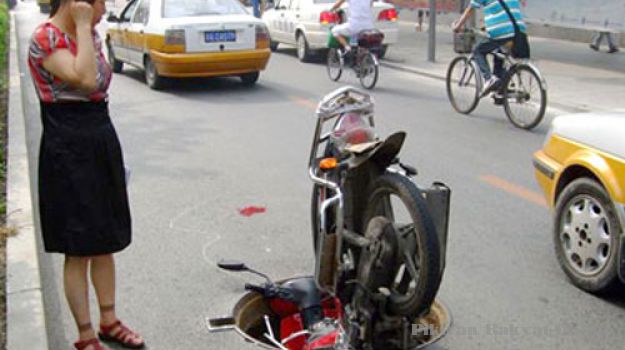
4. Vehicle Damage and Public Safety Risks
One of the most serious consequences of a failed manhole cover is the potential safety risk.
A manhole cover that becomes cracked, displaced, deformed, or collapses under traffic can create a dangerous opening or uneven surface.
In public roads, parking areas, commercial developments, and logistics facilities, this can potentially result in:
Vehicle Damage
Vehicles passing over a failed manhole cover may suffer damage such as:
- Tyre punctures or failure
- Wheel or rim damage
- Suspension damage
- Underbody damage
- Loss of vehicle control
The severity of the damage can depend on the location, traffic conditions, vehicle type, and extent of the manhole cover failure.
Injuries to Road Users
A failed or missing manhole cover can also pose a risk to motorcycles, cars, pedestrians, and other road users.
In more severe incidents, injuries can range from minor physical injuries to serious or potentially life-threatening accidents.
For this reason, load class selection should not be viewed simply as a purchasing decision. It is an important part of infrastructure safety planning.
5. Legal Claims, Compensation, and Liability
Another potential cost is liability following an infrastructure-related incident.
Where a failed manhole cover contributes to an accident, the responsible project owner, facility operator, contractor, or other party may potentially face claims depending on the circumstances and applicable local laws.
Potential costs may include:
- Vehicle damage compensation
- Medical expenses
- Property damage claims
- Legal and administrative expenses
- Investigation and repair costs
- Other liabilities arising from the incident
The exact responsibilities and legal consequences will depend on the project arrangement, contractual obligations, applicable regulations, and circumstances of the incident in the relevant jurisdiction.
Nevertheless, the principle is straightforward: preventing infrastructure failure is generally far more cost-effective than dealing with its consequences.
Choosing the Right Manhole Cover Load Class for the Application
The correct manhole cover load class should be determined based on the actual conditions of the installation area.
Traffic assessment is particularly important for projects located in public or vehicle-accessible areas. The project team should consider factors such as:
- Type of vehicles using the area
- Maximum expected vehicle load
- Traffic frequency
- Whether heavy trucks or specialised vehicles will pass over the cover
- Installation location
- Road and pavement conditions
- Whether the area is pedestrian-only, vehicle-accessible, or subject to heavy traffic
For example, under EN 124, load classes range from A15 for pedestrian areas through higher classes such as B125 and C250 for areas exposed to vehicle traffic, while D400 to F900 are intended for applications involving significantly higher loads.
The appropriate class should always be selected according to the actual application and project requirements rather than simply choosing the lowest-cost option.
A Lower Initial Price Does Not Always Mean Lower Cost
For infrastructure projects in the UAE and Saudi Arabia, cost efficiency should be evaluated beyond the initial purchasing price.
A lower-priced manhole cover may appear attractive during procurement, but if its load class is inadequate for the application, the project could face much higher costs later through:
Premature replacement + civil works + labour + transportation + traffic disruption + safety risks + potential claims.
This is why manhole cover selection should be approached as a long-term infrastructure investment, rather than simply a procurement exercise.
Before finalising the specification, project teams should conduct an appropriate site and traffic assessment and confirm the expected loading conditions with the relevant project stakeholders.
Accurate measurement and proper application assessment are also essential to ensure that the selected manhole cover meets the technical requirements of the installation area.
The goal is not simply to choose the cheapest manhole cover. The goal is to choose the right manhole cover for the application—because the cost of failure can be far greater than the initial saving.
Writer: Tika Diana | Editor: Tri Rahayu
ALSO READ:






Leave a Reply