
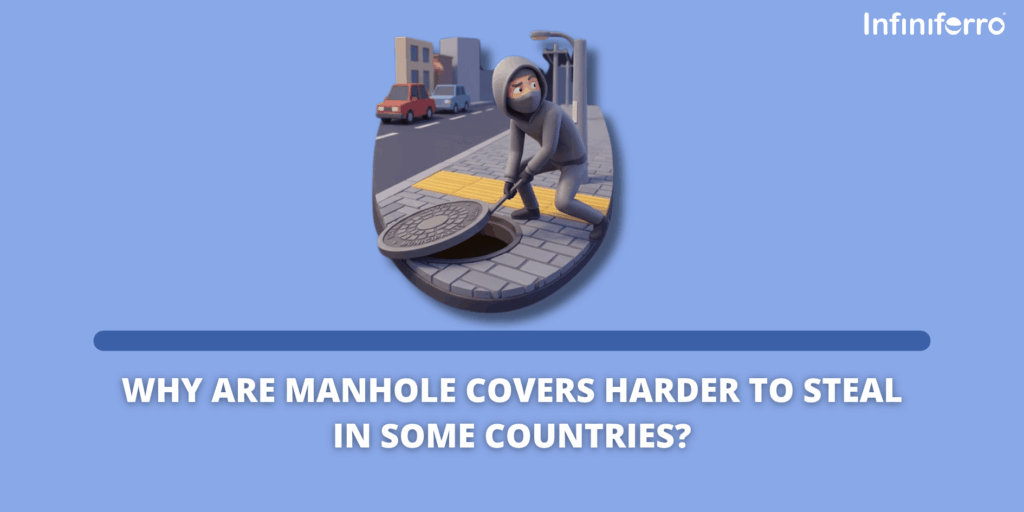
Why are manhole covers often stolen? What makes manhole covers more difficult to steal in modern cities? There are several reasons that we will discuss in this article, including anti-theft design, comprehensive monitoring, and stronger regulation of the supply chain.
Manhole covers are an essential part of urban infrastructure. They protect access points to underground drainage, sewerage, telecommunications, electrical, and utility networks while helping keep roads and pedestrian areas safe.
However, because many traditional manhole covers are made from cast iron or ductile iron, they can also become targets for theft. Once a heavy manhole cover is removed, the open access point can create a serious hazard for pedestrians, cyclists, and vehicles.
In some countries, however, the risk of manhole cover theft is reduced through a combination of smarter product design, monitoring technology, public surveillance, and stricter control of the scrap-metal market.
What Makes Manhole Covers More Difficult to Steal?
1. Anti-Theft Manhole Cover Design
One of the most direct ways to reduce theft is to make the manhole cover itself more difficult to remove.
Traditional covers may simply sit inside a frame. Modern designs can incorporate additional security features that prevent unauthorized removal while still allowing authorized personnel to access underground utilities for inspection and maintenance.
Hinged Manhole Covers
A hinged manhole cover is permanently connected to its frame, making it much more difficult to completely remove and carry away.
Depending on the design, the cover can also include locking mechanisms or other security features. This approach can be particularly useful in locations where frequent maintenance access is required but unauthorized removal needs to be prevented.
Hinged covers are one of the physical approaches used to make unauthorized removal more difficult.
For infrastructure owners, the advantage is relatively simple: even if someone attempts to open the cover, taking the entire unit away becomes significantly more complicated than removing a loose cover.
2. Smart Sensors and IoT Monitoring
Physical security is only one part of the solution. Technology can also help cities detect unusual activity around manhole covers.
Research into smart manhole systems has demonstrated the use of sensors to detect movement, tilting, displacement, damage, and even missing covers. Data can then be transmitted to authorities or maintenance teams through IoT networks.
For example, an intelligent manhole monitoring system can use an accelerometer or tilt sensor to detect when a cover has been moved from its normal position. LoRaWAN-based systems have also been proposed to send alerts to maintenance departments when a manhole cover is moved or damaged.
More recent research has explored smart manhole alarms capable of detecting abnormal displacement and water immersion in real time.
This changes the approach to infrastructure security.
Instead of waiting for someone to discover that a manhole cover is missing, a monitoring system can potentially alert the responsible authority shortly after an abnormal movement occurs.
For smart cities, this can help reduce inspection time, improve response speed, and protect public safety.
3. CCTV and Urban Surveillance
Technology installed directly on a manhole cover is not the only monitoring method available.
CCTV networks, traffic cameras, smart-city platforms, and other surveillance systems can provide an additional layer of protection around public infrastructure.
The role of surveillance and street lighting making unauthorized activity more difficult to carry out unnoticed.
The effectiveness of surveillance does not necessarily depend on identifying every suspicious action automatically. Even conventional camera systems can provide valuable evidence when an infrastructure theft occurs.
In Singapore, for example, the police have publicly described cases in which CCTV and police camera images helped investigators identify suspects involved in theft and trace stolen materials to scrap-metal businesses.
This illustrates an important principle: protecting public infrastructure is not only about the physical product. It is also about creating an environment where theft is difficult to carry out and easier to investigate.
4. Controlling the Scrap-Metal Supply Chain
There is another important side of the problem: what happens after a manhole cover is stolen?
Cast iron has commercial value as scrap metal, which can create an incentive for theft. Therefore, reducing the opportunity to sell stolen infrastructure can be just as important as preventing the theft itself.
The original article emphasizes the importance of controlling scrap-metal channels and making stolen infrastructure more difficult to sell.
This approach is based on a straightforward idea:
If stolen infrastructure cannot easily be converted into cash, the incentive to steal it becomes lower.
Regulation of secondhand-goods and scrap-metal businesses can therefore play an important role. In Singapore, for example, police investigations into stolen copper wire have included scrutiny of the scrap-metal company that allegedly received the material.
This demonstrates how enforcement can extend beyond the person physically committing the theft and into the wider chain through which stolen materials are handled.
5. Unique Identification and Traceability
Another useful security measure is giving infrastructure components a unique identity.
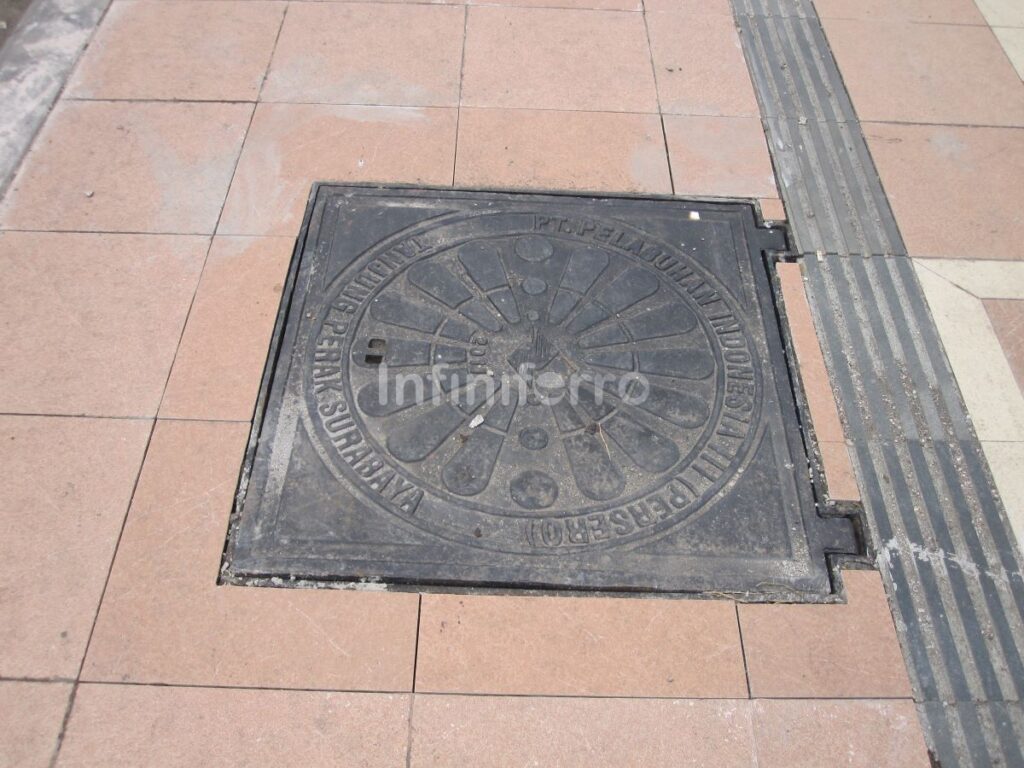
Manhole covers can be marked with serial numbers, manufacturer information, project identification, logos, or other traceable markings. Unique numbers, city logos, and QR codes can make ownership easier to identify and can increase the risk associated with reselling or processing stolen covers.
For large infrastructure projects, traceability can also help asset owners manage maintenance.
A unique identification system can potentially connect a manhole cover to information such as:
- Product specifications
- Installation location
- Load class
- Manufacturing batch
- Project information
- Inspection records
- Maintenance history
This makes the manhole cover more than just a physical component. It becomes a traceable infrastructure asset.
6. Alternative Materials Can Reduce Scrap Value
Another strategy is to use materials that have lower resale value as scrap.
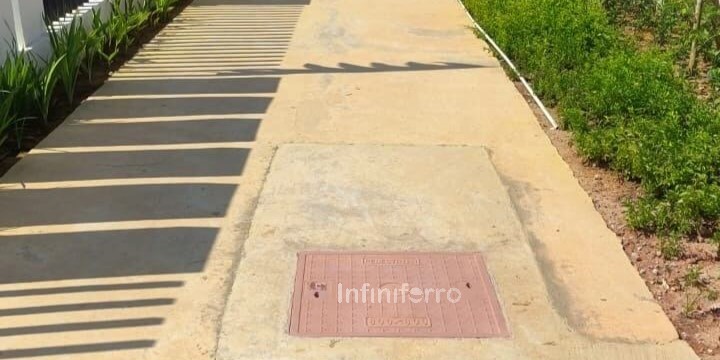
Composite materials such as FRP (Fiber Reinforced Polymer) can provide an alternative to conventional metal covers in applications where their technical properties are suitable.
FRP drainage covers can offer advantages such as corrosion resistance, relatively low weight, and reduced scrap-metal value compared with cast iron products.
Composite materials are one potential way to address the economic incentive behind metal theft.
However, material selection should always be based on the requirements of the application. Areas exposed to heavy vehicle traffic, for example, require appropriate structural and load-bearing performance.
Therefore, replacing metal with composite material is not necessarily the answer for every project. Instead, it can be considered as part of a broader infrastructure security strategy to make manhole covers harder to steal.
Why Infrastructure Security Requires More Than a Strong Manhole Cover
The problem of manhole cover theft cannot be solved simply by making the cover heavier or stronger.
A more effective strategy involves several layers of protection.
First, improve the physical design. Hinges, locks, and other security features can make unauthorized removal more difficult.
Second, introduce monitoring technology. Sensors and IoT systems can help detect movement or missing covers more quickly.
Third, strengthen surveillance. CCTV and other monitoring systems can help detect theft and support investigations.
Fourth, control the resale market. Stronger regulation and traceability can make it harder for stolen infrastructure to enter legitimate scrap-metal channels.
Finally, select the right material. Cast iron, ductile iron, and FRP each have different characteristics and should be selected according to the location, loading requirements, environmental conditions, and security considerations.
Conclusion
Manhole cover security is ultimately a combination of product design, technology, monitoring, and regulation.
Countries and cities that want to reduce manhole cover theft do not have to rely on a single solution. Hinged and secured designs can make physical removal more difficult, while IoT sensors can provide early warnings when a cover is moved or missing. CCTV and other surveillance systems can add another layer of protection, while stronger control of scrap-metal channels can reduce the economic incentive behind theft.
Research into smart manhole monitoring continues to demonstrate how sensors, wireless communication, and cloud-based systems can help cities respond more quickly to missing or displaced covers.
Ultimately, a secure manhole cover is not simply a piece of metal placed over a hole. It is part of a larger urban infrastructure system that needs to be designed for safety, durability, traceability, and security.
For modern infrastructure projects, choosing the right manhole cover should therefore involve more than considering load capacity and price. Security features, material selection, traceability, maintenance requirements, and the surrounding environment should also be taken into account.
ALSO READ:






Leave a Reply